Political scientist and researcher with over a decade of experience supporting anti-corruption and good governance projects for organizations including Transparency International, Freedom House, and the European Commission.
I am a political scientist and researcher with over a decade of experience working at the intersection of academia and the non-profit sector. My work spans political economy, anti-corruption, and good governance, with a focus on translating research into actionable insights.
I have collaborated with various organizations on anti-corruption and democratization projects, including Transparency International, Freedom House, the European Commission, and the Government Transparency Institute. In these roles, I have supported NGOs in mapping the quality of open data for political integrity in the Western Balkans, analyzed political finance regulations to identify corruption vulnerabilities, utilized big data and network analysis to detect corruption risks in public procurement, authored democratization reports and country profiles, and conducted project evaluations.
My academic research examines the evolving nature of political-business networks, their influence on the allocation of public funds, and their effects on institutional development, democratic backsliding, and the durability of illiberal regimes. I have published in journals such as Comparative Political Studies and Europe-Asia Studies. My forthcoming book with the University of Michigan Press draws on original corporate registry data and interviews with oligarchs, politicians, and bureaucrats to understand the political logic of renationalization in Serbia.
I have taught courses on state capture and political economy at institutions including Central European University in Vienna and Eötvös Loránd University in Budapest. I hold a PhD in Political Science from Central European University.
Research Experience
Selected Current Positions
Consultant - Anti-Corruption Helpdesk
Transparency International
Jan 2021 – Present
Authored over 20 desk-based research papers on anti-corruption topics, including public integrity, harnessing artificial intelligence for anti-corruption, and safeguarding donor funds from corruption.
Freedom in the World 2027 Analyst
Freedom House
July 2026 – Present
Contributing analyst for the annual Freedom in the World report, assessing political rights and civil liberties in North Macedonia.
Previous Positions
Expert Evaluator
European Commission
Brussels · Oct 2025 – Jan 2026
About this role
Evaluated project proposals at the European Education and Culture Executive Agency (EACEA).
Consulting
Freedom in the World 2026 Analyst
Freedom House
Washington, D.C. · Jun 2025 – Jan 2026
About this role
Authored North Macedonia country report for the annual Freedom in the World report, assessing the state of political rights and civil liberties.
Consulting
Consultant - CEPI Project
Transparency International
Berlin · Jan 2024 – Mar 2025
About this role
Contributed to creating a database of grand corruption cases in the Western Balkans and Turkey. Responsibilities included writing, editing, proofreading, and fact-checking high-level corruption cases.
Supported Transparency International's national chapters in the Western Balkans and Turkey in scoping relevant datasets, reviewed national data scoping reports, drafted two regional reports on the quality of political integrity open government data and on the regional regulatory framework for political finance, public contracting, and asset disclosure with actionable recommendations, and liaised between national chapters and web developers to build functional datasets for the Integrity Watch Platform.
Consulting
Postdoctoral Fellow
Higher School of Economics
Moscow · Sep 2020 – Aug 2021
About this role
Worked as a postdoctoral fellow at the International Center for the Study of Institutions and Development (ICSID) at the Higher School of Economics in Moscow.
Academic
Consultant
Government Transparency Institute
Budapest · Jan 2019 – Jul 2019
About this role
Consultant for the 'State Capture and Defense Procurement in the EU' project, responsible for the UK case study. Conducted document analysis in the field of defense procurement, carried out fieldwork including interviews with key players and experts in the defense sector, delivered the report on findings, and contributed to the organization of workshops for dissemination of results.
Conducted research on the role of political party-business networks in the process of renationalization.
Academic
Visiting Scholar
University of California Santa Cruz
Santa Cruz, CA · Oct 2017 – Dec 2017
About this role
Visiting Scholar at the University of California Santa Cruz.
Academic
Assistant Archivist
Vera and Donald Blinken Open Society Archives (OSA)
Budapest · Jun 2016 – Jul 2017
About this role
Digitized data using archival material (video and textual) from Yugoslavia in the 1990s. Collected and evaluated structured information from predefined archival collections (both analog and digital), entered data into databases, selected and digitized documents, and prepared short analytical summaries of the collections.
Academic
Publications
Peer-Reviewed Academic Articles
Journal Article2026
From Prosecution to Co-optation and Capture: Electoral Uncertainty and Reversals of Anti-Corruption Efforts in Serbia
Europe-Asia Studies
This article examines why incumbents in electoral democracies reverse initial efforts to prosecute political corruption committed under previous governments. Using a process-tracing comparison of Serbia before and after the 2014 elections, it argues that varying levels of electoral uncertainty shape incumbent incentives. High electoral uncertainty incentivises prosecutions to broaden electoral support, while consolidation of power shifts priorities towards co-opting business and political elites and judicial capture. Co-optation secures resources to finance the incumbent’s political machine and weakens the opposition, while judicial capture addresses the strategic fear of insulated courts and prosecutors potentially threatening the incumbent’s own corrupt network.
Capture Me If You Can: The Road to the Political Colonisation of Business in Post-Milošević Serbia
Europe-Asia Studies
This article analyses the nature and the evolution of state capture in Serbia. I approach this process from a micro-level perspective, utilising interview data and rich case studies, focusing on the interaction between political parties and business. In the context of high political uncertainty and underdeveloped institutions in the period 2000–2012, oligarchs benefited from the privatisation process and resource extraction, while political parties were after short-term extraction. After 2012, amid low political uncertainty, a top-down political colonisation by the ruling party can be observed, manifesting through the involvement of businesses directly owned by political officeholders or their families in the state-capture dynamic.
Network Ties and the Politics of Renationalization: Embeddedness, Political-Business Relations, and Renationalization in Post-Milosevic Serbia
Comparative Political Studies
Based on an original large-N data set of Serbian firms privatized between 2002 and 2011, and qualitative evidence, this article applies survival modeling to network data to analyze the political foundations of renationalization. Building on embeddedness scholarship, the study hypothesizes that renationalization is influenced by varying patterns of embeddedness of firms in political and ownership networks. The findings show that politically connected firms are more likely to be renationalized than non-politicized ones.
Selected Policy Reports, Desk-Based Research & Analyses
Desk-Based Research2026
Domestic Interagency Coordination in Anti-Corruption: The Case of the UK and International Best Practice
Transparency International & U4 Anti-Corruption Resource Centre
This Helpdesk Answer examines interagency coordination in anti-corruption efforts in the UK, focusing on three key dimensions: data sharing, referral processes and multi-agency coordination mechanisms. Effective coordination is critical for reducing duplication, closing enforcement gaps and addressing complex corruption cases that often intersect with other forms of criminality. The UK benefits from a strong legal framework for data sharing, established referral pipelines and dedicated coordination bodies. However, persistent challenges remain, including institutional fragmentation, siloed data, inconsistent data-recording practices, capacity constraints, and weaknesses in whistleblower reporting mechanisms and case prioritisation. International experience highlights practical approaches to strengthening coordination, including interoperable data systems, structured corruption risk assessments, multi-disciplinary teams, improved whistleblower protection and the use of advanced analytics and artificial intelligence.
Harnessing Artificial Intelligence (AI) for Anti-Corruption
Transparency International & U4 Anti-Corruption Resource Centre
Artificial intelligence (AI) is increasingly being applied to anti-corruption efforts, offering significant opportunities and introducing new challenges. Evidence from academic studies and public policy applications shows that AI can strengthen prevention by predicting corruption risks and hotspots in public fund allocation, as well as by deterring petty corruption through simplified procedures and citizen access to accurate information. In detection, AI has been used to analyse political integrity datasets and satellite imagery, enabling the identification of risky tenders, fake bidders, conflicts of interest and environmental harms linked to corruption.
Transparency International & U4 Anti-Corruption Resource Centre
Rapid donor exits have been on the rise in recent years, driven by shifting geopolitical priorities, domestic budget pressures and evolving aid strategies. When poorly coordinated and if responsibilities shift too abruptly to local actors, exits can face corruption risks such as the diversion of residual funds, favouritism in fast-tracked hiring, procurement manipulation and reduced whistleblowing capacities. Donors rarely have exit-specific anti-corruption frameworks, but practices such as corruption risk management, proactive auditing and remote monitoring may help safeguard funds and assets.
Alternative Strategies to Improve Public Sector Integrity in Contexts Characterised by Systemic Corruption
Transparency International & U4 Anti-Corruption Resource Centre
Contexts characterised by systemic corruption require alternative strategies to anti-corruption programming to effectively enhance public sector integrity. Traditional anti-corruption interventions rooted in the principal-agent model — such as strengthening monitoring systems and promoting transparency — are unlikely to succeed on their own but can be more effective when complemented by alternative strategies that are sensitive to local contexts and realities. These strategies include social norms interventions, social empowerment, reducing vulnerabilities to corruption, horizontal enforcement and top-down leadership changes.
Mitigating Corruption in the Reconstruction of Lebanon
Transparency International & U4 Anti-Corruption Resource Centre
Lebanese and international stakeholders have spearheaded reconstruction efforts in response to recent national challenges, such as the Beirut port explosion and the conflict between Israel and Hezbollah. Corruption – especially patronage, clientelist networks and state capture – undermines these efforts by weakening planning processes, public contracting and the delivery of construction, waste management and related services. While progress has been made in passing anti-corruption laws, local NGO watchdogs note significant challenges in their implementation. Some donors elect to bypass the state in the short term, instead channelling aid through trusted local and international networks while simultaneously investing in the capacity of Lebanese oversight institutions.
Accountability, Loading: A Survey of Open Data for Enhancing Political Integrity in the Western Balkans and Turkey
Transparency International
This report underscores how open data can be utilised to uphold political integrity in the Western Balkans and Türkiye, focusing on three key areas: political financing, law-making and resource allocation. These three areas are of particular significance for anti-corruption and political integrity in the region given the existing evidence of opaque political finance, the undue influence of vested interests in law-making and favouritism in public contracting.
The Relationship Between Electoral Integrity and Corruption
Transparency International & U4 Anti-Corruption Resource Centre
The literature broadly finds that improved electoral integrity has a constraining effect on corruption, but this relationship is largely dependent on the existence of conditions that enable voters to hold politicians accountable for corrupt behaviour. Specific measures considered especially significant include political finance measures such as subsidies and financial disclosure laws, building the capacity of election management bodies and the presence of an open media environment.
Integrity training for public officials aims to raise awareness about integrity standards and corruption prevention in the public sector. They can focus on various areas including codes of conduct and ethics, conflict of interest, ancillary activities, pre and post-employment rules, proactive disclosure and others. Recent experiences from countries that provide integrity training suggest there is a growing use of e-learning tools that combine theory and interactive material in the form of videos or case-based scenario exercises. These types of training provide more flexibility and are cost effective. Evaluations on the effectiveness suggest the benefits of short, thematic modules and interactive content for efficient learning.
Public-Private Relationships in Defence Procurement in the EU: The Case of the UK
Government Transparency Institute
This paper relies on both quantitative and qualitative data in analyzing major corruption and state capture risks in the defence procurement process in the UK.
Analyzing State Capture in Post-Communist Countries and Beyond (MA level)
Introduction to Political Economy: Interests, Institutions and Ideas (BA level)
Visiting Faculty
Eötvös Loránd University
Budapest, Hungary · Sep 2021 – Jan 2022
Courses Taught
Analyzing State Capture in Post-Communist Countries and Beyond (BA level)
CEU Global Teaching Fellow
Eötvös Loránd University
Budapest, Hungary · Aug 2019 – Jan 2020
Courses Taught
Analyzing State Capture in Post-Communist Countries and Beyond (BA level)
Teaching Assistant
ECPR Summer School in Methods and Techniques
Central European University · Aug 2019
Courses Assisted
Social Network Analysis and Visualization with R
Teaching Assistant
ECPR Summer School in Methods and Techniques
Central European University · Jul 2017
Courses Assisted
Theoretically Informed Network Analysis for Social Scientists
Teaching Assistant
Central European University
Budapest, Hungary · Jan 2016 – Apr 2016
Courses Assisted
Political Economy II (BA level)
Education
2014 – 2019Summa cum laude
Doctor of Philosophy (Ph.D.)
Comparative Politics
Central European University • Budapest, Hungary
Thesis: Network Ties and the Politics of Renationalization: Embeddedness, Political-Business Relations and Renationalization in Post-Milosevic Serbia
2013 – 2014GPA: 3.70/4.00
Master's Degree
Political Science
Central European University • Budapest, Hungary
Thesis: News Coverage of Domestic Violence in Serbia
2009 – 2011GPA: 9.87/10
Master's Degree
Political Theory, Political Sociology and Institutions
University of Belgrade, Faculty of Political Sciences • Belgrade, Serbia
Thesis: Twilight of Democracy and Rise of Authoritarianism: Impediments to Democratization in Central Asia
2005 – 2009GPA: 9.37/10
Bachelor's Degree
Journalism and Communication
Faculty of Political Sciences, University of Belgrade • Belgrade, Serbia
Thesis: News Agencies in Serbia: Development and Changes
News
Book news
Forthcoming February 2027
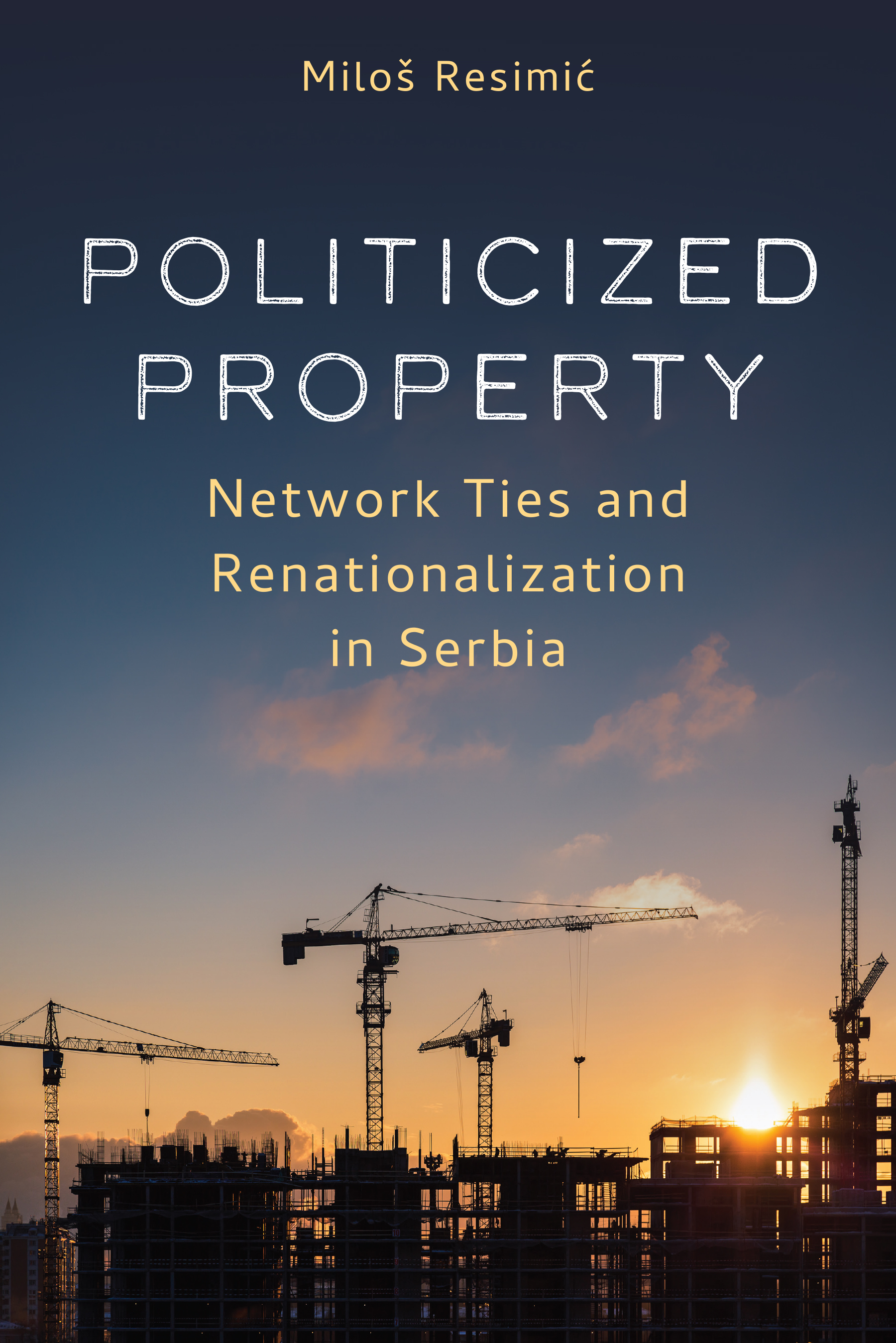
Politicized Property
Network Ties and Renationalization in Serbia
Forthcoming from the University of Michigan Press, the book examines
how political-business networks shape ownership reversals and why
some privatized firms are targeted for renationalization while
others are protected.